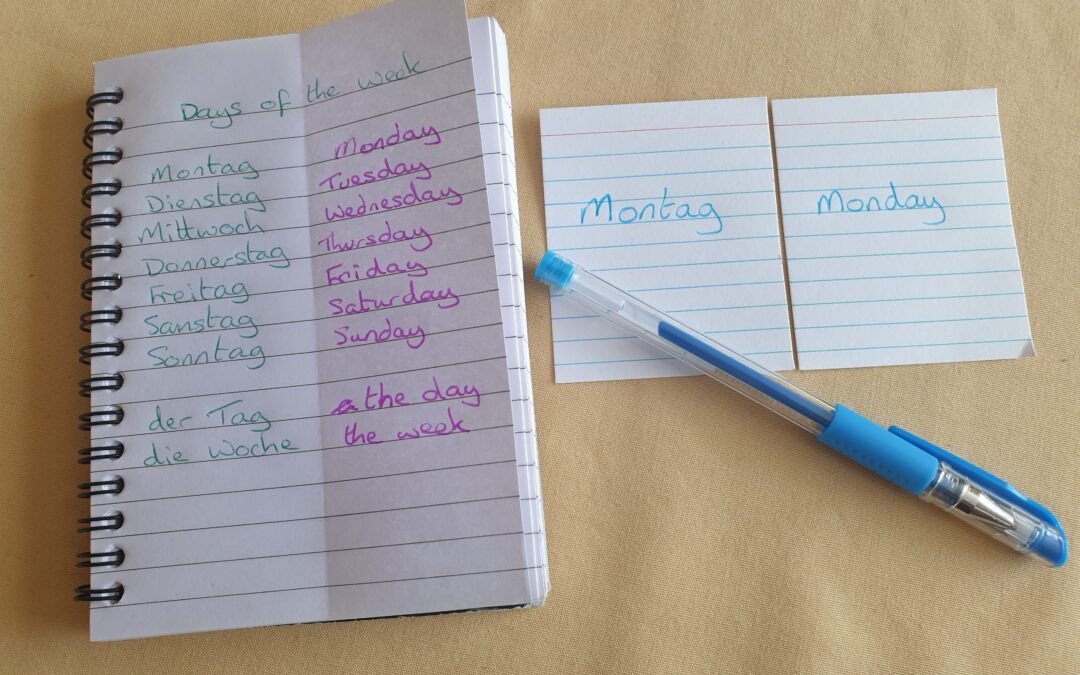
If you are anything like me, then the term “learning vocabulary” may bring back memories of school. A list of words that you absolutely have to learn in time for a test – knowing that a poor mark means a retest, or maybe a detention. Or maybe your school simply didn’t do vocabulary tests (a common situation these days) and so you didn’t learn your new words, which may have had a noticeable effect on your learning outcomes. Sadly, there is no denying that learning words is an essential part of learning a language, so here is Part 2 on “Tips for learning vocabulary”.
If you always have to use a dictionary (whether online or paper) every time you want to say something, then it is no wonder that so many people use translation software. It may be no surprise that I am limited in my enthusiasm for such software – besides the sometimes hilarious errors it can make, I also find that it is often used as a solution rather than a tool, and that it limits a student’s ability to recognise links between words and to work out which option they need when there are several choices.
So, besides learning for yourself and reducing reliance on technology, what other tips can I offer on learning vocabulary?
Make a vocabulary book. I mentioned it last month, but if you don’t make a note of the new word, you won’t remember the new word or think to try and learn it. A simple small notebook will do, preferably divided into topics so that all clothes are in one area, food in another, rather than one long muddled list. Keep it to hand. If you make notes on your phone, do remember to transfer them to the book.
Learn the genders of the words at the same time as you learn the word itself. If a language uses gender for words like “table” then that will have an effect on other words later on, such as adjective endings. The photo attached shows a beautiful picture made by one of my adult students to help her remember the words and genders of parts of the body. Each body part has been coloured in a way to show the gender of the word (pink for feminine, blue for masculine). This way when she thinks of the word, she can picture the image and see whether it was a pink word or a blue one.
Practice with a friend. If you know someone else learning the same language, or have someone helpful in your circle, then why not make a game and test each other? Who can score the highest?
Test yourself regularly. Even if you don’t have a teacher to mark them, set yourself tests and practise regularly. Maybe try a mind-map or a “word splurge”. Write a key word in the middle of your piece of paper (e.g. clothes) then write every word you can think of on that topic. A mind-map would link them together, a “word splurge” is just that – a bunch of words with no obvious structure to the arrangement.
Tips #5? – This one’s a cheat, but try reading last month’s blog for more ideas!
I hope these tips for learning vocabulary are helpful. We all have our own way of learning, so try out a few different ideas and see what works best for you.
Learning a language involves so many different skills. One fact that you really cannot avoid though, is that you will need to learn vocabulary at some point. If, like me, that brings back memories of sitting in front of an exercise book with a list of 20 words and trying desperately to memorise them before Monday’s test, then this may not be your favourite task.
The good news is that there are many different ways to learn and that you should be able to squeeze one or two of them into your routine. Here are 10 tips for learning vocabulary:
Keep a vocabulary notebook handy so that you can keep all your vocabulary in one place. When you see a new word, write it down. It seems obvious, but however sure you are that you will remember that “un éclair” is French for “lightning bolt” the chances are that you will soon forget as you focus instead on your next meeting or to-do list.
Can you make any mental links to help you remember the word? For me, the above example gives a mental picture of chocolate eclairs raining down, accompanied by a soundtrack of thunder.
Even better – spend time each week using those new words in a sentence so that you can practice context.
When you write down a word, make sure that you include relevant grammatical information too. For some languages the gender of a noun is very important, for verbs it may be the past participle.
“Little and often” is best. The process of moving information from short term memory to long term memory is best achieved by regular practice. You can’t learn to play a musical instrument by doing one four-hour mammoth session per month and the same applies to languages. 10 minutes vocabulary practice 3-4 times per week is better than half an hour the night before your next class!
Keep this week’s vocabulary in an obvious place so you can review it regularly. Maybe that is by the kettle so you re-read it every time you make a cup of tea. Alternatively, maybe by the bathroom mirror so you see it as you clean your teeth. Whatever works for you.
Consider using apps and online resources to help. Programmes such as DuoLingo can be invaluable as they provide chances for repetitive practice in an easy-to-use format.
If you learn better by doing rather than seeing or hearing, then you may find that flashcards are helpful. You can make physical flashcards, or use software such as Quizlet for an online version.
Keep on top of it. 10-20 words per week may seem like a little, but busy lives can get in the way of the best intentions. Before long you have a list of 50 or 100 words and the task begins to look more daunting. Especially in the case of exam students and those with a learning deadline, making sure you keep on top of your vocabulary learning will make revision much less stressful.
Advanced learners – look up other relevant words as well. So, if you have the concept of “lesson” then also look up “learn”, “learner”, “student”, “teacher”. If it is a verb such as “to surprise” then also learn the noun “a surprise”, the adjective “surprising” and the adverb “surprisingly”. This kind of focused work will help you to see the patterns of language formation and also widen your vocabulary beyond the simple first word which you wrote down.
Finally, review your vocabulary regularly. It is easy to add in new words and then forget the old through a lack of practice. If you find that you can no longer recall the word for “shirt” then take time to check you can remember the rest of the wardrobe as well!
If you are really keen you could write mini-tests for yourself as you go. If you keep them in the back of your folder or notebook then you can check regularly which topics are due for revision!
Please come back next month to read Learning Vocabulary Part 2: 5 Study Tips 🙂
So, the GCSE and A Level exams are over, and a long summer stretches ahead of us. What do the tutors do during the summer holidays – just relax, right?
Well, if I am writing a blog about it, then there is a fair chance that the answer is “No! We don’t just relax!”. Here are a few of the things I will be getting up to in July and August.
Planning for the term ahead. That isn’t just for schoolteachers. Those who like to work smarter rather than harder will use some of their free time to get ahead of the curve. That may mean reading up on a new curriculum, exam techniques and teaching methods, or simply getting ahead on the lesson plans for each of the students I am expecting in September.
Producing new material. Yes, this does technically come under the idea of planning for the term ahead. Creating new games, activities and even worksheets all take time, so looking back at notes from past classes can give some hints as to which extra materials would be useful. I like to jot ideas down on my phone during the term and then develop the ones which I think will be most useful.
Accounts. Never the most thrilling of tasks, but getting on with the accounts and preparing the tax return for the last financial year is always easier if you are not trying to teach a full timetable at the same time!
Marketing! This should be an all-year-round task, but networking in particular can be hard to make time for when you are in an in-person teaching position. Writing blog posts, preparing advertising, planning social media posts, updating the website…
Clearing the decks at home. I really hope I am not the only tutor who finds that household tasks can slip during the busy exam-preparation period. Fixing a dripping tap, spring cleaning (well, summer cleaning) and having a good declutter all help set up the household for the new academic year. Yes, I genuinely did finally get round to having two drippy taps fixed, and am happy to recommend our lovely plumber to anyone who is in the area!
Reading. I love reading, but so rarely have time to read books for pleasure. While I have some more time available to do so, I will definitely be working through the pile of unread books that have been gathering dust over the last year. I will also be reading the A Level texts that my students will be working on from September, so that I can refresh my memory of the texts and plan which order we will address the relevant tasks.
Teaching! Unlike schoolteachers, independent tutors often continue to work during the holiday seasons. Whether that be helping school students to catch up from the past year (or get ahead for the next one) or continuing classes for adult learners, I am pleased to say that I will continue to teach while the schools have their summer break.
Holiday. Around all of the above we will also be fitting in some time away from home and work. Definitely time for a much-needed rest and recharge.
As our thoughts turn to holiday season, now is a great time to consider whether your language skills are also ready. Check out our tips and ideas for making the most of the summer season to brush up your language skills.
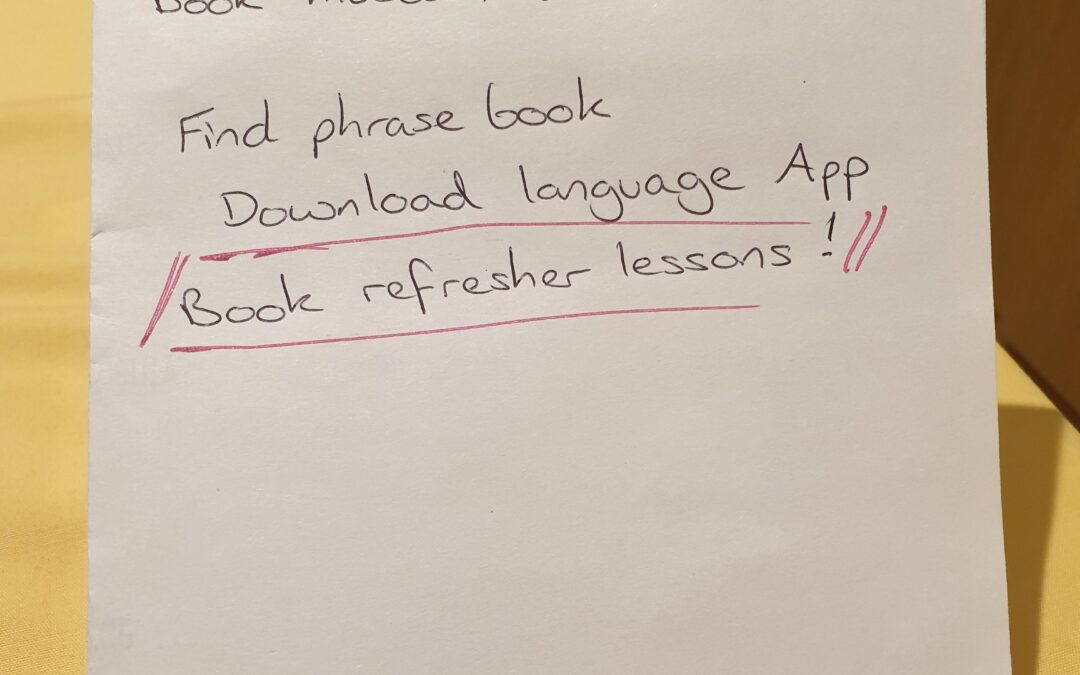
Already have some language skills? If it has been a while since you last used them, then consider warming them up before you go. You could use a language-learning app to refresh your vocabulary or try finding a podcast for some extra practice.
Talking of podcasts, why not check out the possibilities for targeted topics such as visiting a café or booking tickets. There are several series of “Coffee Break” language podcasts (Coffee Break French, Coffee Break German etc). If you look at the titles you can usually see what is covered in each one.
Food – If you have allergies or dietary requirements then it would be a really good idea to work out how to talk about them in your chosen language. Maybe make a small card with the key details on it so that you can show the restaurant staff.
While you are away, take the opportunity to pick up real-life materials to help with your language-learning. Choose the museum leaflet in French as well as the one in English, take a photo of the German menu, visit a newsagent and buy some authentic reading material. Whatever suits your level and your interests.
A short, sharp burst of language classes may be just what you need to give you the confidence to enjoy your holiday more – whether that is because you are able to ask for directions (and understand the answers!), or to explain your dietary needs in that chic restaurant you want to visit.
Language Learners will be running summer holiday classes throughout July and August. Drop us a line if you would like details of our French and German summer lessons. teri@language-learners.com
This website uses cookies to improve your experience. We'll assume you're ok with this, but you can opt-out if you wish.AcceptRead More
Privacy & Cookies Policy
Privacy Overview
This website uses cookies to improve your experience while you navigate through the website. Out of these, the cookies that are categorized as necessary are stored on your browser as they are essential for the working of basic functionalities of the website. We also use third-party cookies that help us analyze and understand how you use this website. These cookies will be stored in your browser only with your consent. You also have the option to opt-out of these cookies. But opting out of some of these cookies may affect your browsing experience.
Necessary cookies are absolutely essential for the website to function properly. This category only includes cookies that ensures basic functionalities and security features of the website. These cookies do not store any personal information.
Any cookies that may not be particularly necessary for the website to function and is used specifically to collect user personal data via analytics, ads, other embedded contents are termed as non-necessary cookies. It is mandatory to procure user consent prior to running these cookies on your website.