
If you are anything like me, then the term “learning vocabulary” may bring back memories of school. A list of words that you absolutely have to learn in time for a test – knowing that a poor mark means a retest, or maybe a detention. Or maybe your school simply didn’t do vocabulary tests (a common situation these days) and so you didn’t learn your new words, which may have had a noticeable effect on your learning outcomes. Sadly, there is no denying that learning words is an essential part of learning a language, so here is Part 2 on “Tips for learning vocabulary”.
If you always have to use a dictionary (whether online or paper) every time you want to say something, then it is no wonder that so many people use translation software. It may be no surprise that I am limited in my enthusiasm for such software – besides the sometimes hilarious errors it can make, I also find that it is often used as a solution rather than a tool, and that it limits a student’s ability to recognise links between words and to work out which option they need when there are several choices.
So, besides learning for yourself and reducing reliance on technology, what other tips can I offer on learning vocabulary?
- Make a vocabulary book. I mentioned it last month, but if you don’t make a note of the new word, you won’t remember the new word or think to try and learn it. A simple small notebook will do, preferably divided into topics so that all clothes are in one area, food in another, rather than one long muddled list. Keep it to hand. If you make notes on your phone, do remember to transfer them to the book.
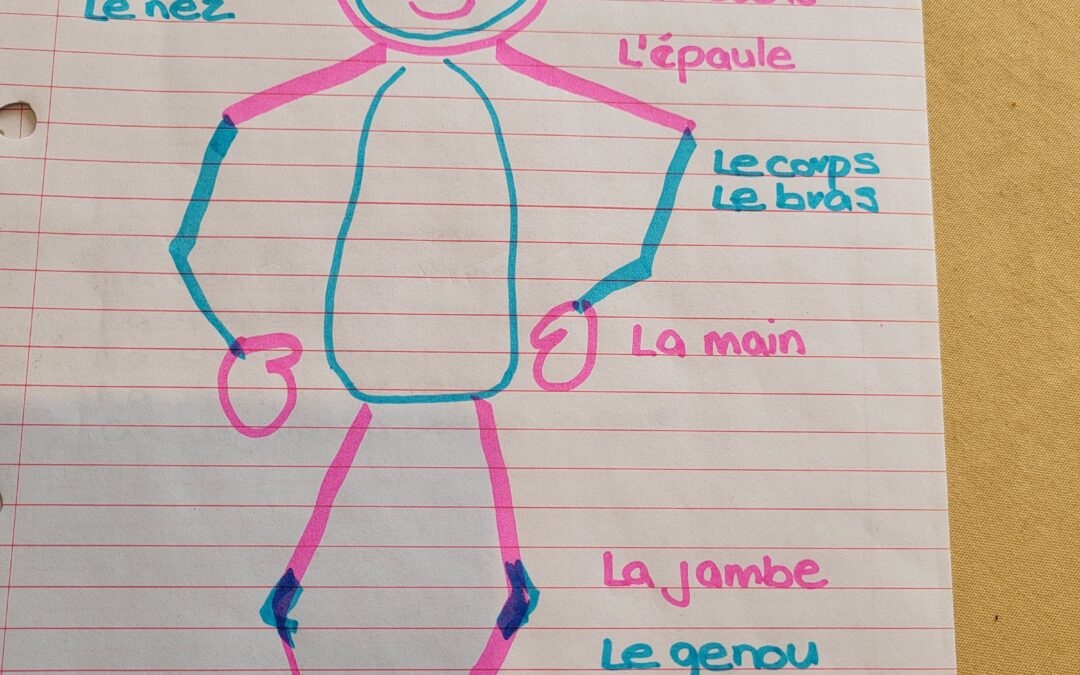
- Learn the genders of the words at the same time as you learn the word itself. If a language uses gender for words like “table” then that will have an effect on other words later on, such as adjective endings. The photo attached shows a beautiful picture made by one of my adult students to help her remember the words and genders of parts of the body. Each body part has been coloured in a way to show the gender of the word (pink for feminine, blue for masculine). This way when she thinks of the word, she can picture the image and see whether it was a pink word or a blue one.
- Practice with a friend. If you know someone else learning the same language, or have someone helpful in your circle, then why not make a game and test each other? Who can score the highest?
- Test yourself regularly. Even if you don’t have a teacher to mark them, set yourself tests and practise regularly. Maybe try a mind-map or a “word splurge”. Write a key word in the middle of your piece of paper (e.g. clothes) then write every word you can think of on that topic. A mind-map would link them together, a “word splurge” is just that – a bunch of words with no obvious structure to the arrangement.
- Tips #5? – This one’s a cheat, but try reading last month’s blog for more ideas!
I hope these tips for learning vocabulary are helpful. We all have our own way of learning, so try out a few different ideas and see what works best for you.