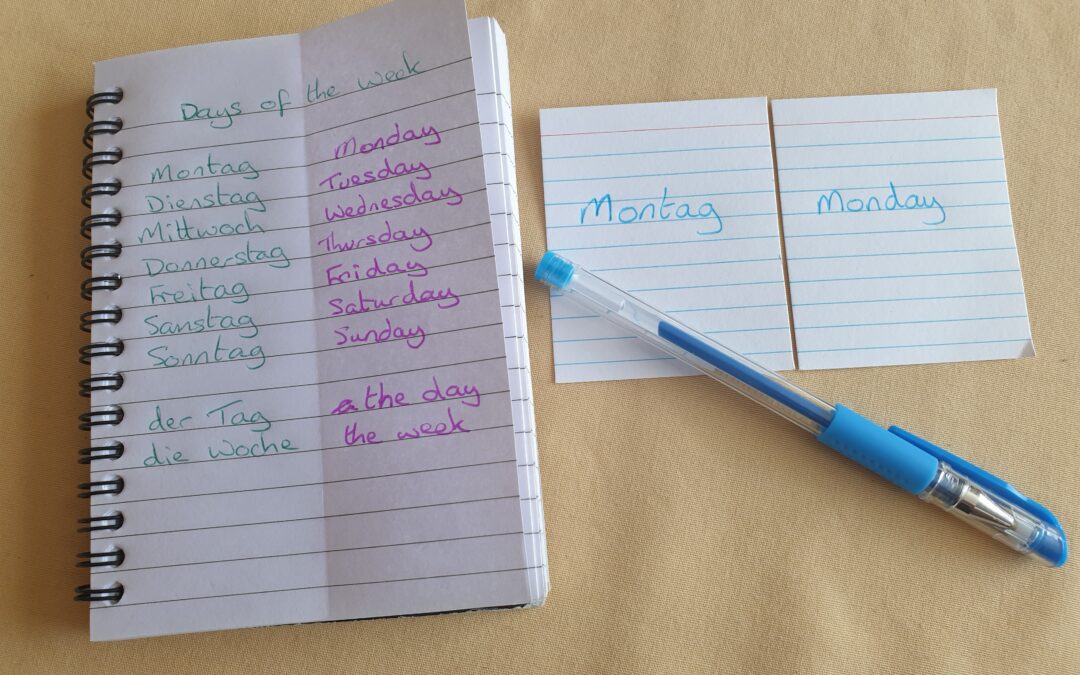
The jump from a good grade at GCSE to the higher expectations of A Level can be a large one. Some students feel unprepared for the expectations of independent study and don’t know where to start, let alone how to structure their time efficiently. If your school tell you to do 10 hours per week independent study on top of what they already set, where do you start? This is especially true with a foreign language where it can be hard to know what to look at or which techniques to use to maximise the return on your time investment. Here are some tips to help you structure your independent study time.
1. A good place to start is by going over your notes from the classes or lectures you have had that week. Don’t leave it too long, or you will forget what was said and may struggle to make sense of your notes.
Re-write your notes if you need to add more details and get busy with highlighter pens and underlining so that you can easily see the key points.
If you have time, write yourself a quiz now, using the information in your notes to form the basis of the questions. Put the quiz in a separate place for later use, so that you have a ready-made resource when it comes to revision time.
2. If you find that there was something you didn’t understand, ask NOW. Ask a friend, look it up in a book or online (make sure your resources are good quality ones!) or even go back to the teacher/lecturer and ask for clarification. Far better to do that within the fortnight, rather than waiting until exam time.
3. With specific regard to languages, it is important to get as much listening practice as possible. Use online resources such as news websites to find articles that you can listen to as well as read. Euronews (www.euronews.com), Deutsche Welle (www.dw.com) and 1jour1actu (www.1jour1actu.fr) are all good examples.
4. Make time to watch the film and/or read the book that you are studying. You are not just watching/reading for pleasure, but you should also be making notes about characters, themes, motivations. Try to get hold of the study guide for that particular work.
5. Vocabulary learning! You may not have a good vocabulary-learning routine in place yet, but this is something that you will need to make dedicated time for if you are to succeed in your exams. Learn the word, its gender, any other related words (the noun from the verb for example). Use active learning methods rather than just reading the paper, and test yourself regularly.
Language Learners can help with the question of independent study and note-taking skills through our Study Skills tutoring sessions. These classes are ideal for those making the jump between GCSE and A Level or for those who are facing exams this year and aren’t sure how to manage their time in order to fit in revision as well as essays and other commitments.
We can help students to establish a regular schedule of personal study on top of their academic and social commitments, as well as giving a range of tips on independent research, essay planning and exam technique.
Learning a language involves so many different skills. You may be feeling daunted by the grammar involved in being able to describe things in the past, present AND future, or by different genders for different nouns. One fact that you really cannot avoid though, is that you will need to learn vocabulary at some point. If, like me, that brings back memories of sitting in front of an exercise book with a list of 20 words and trying desperately to memorise them before Monday’s test, then this won’t be your favourite task.
Sadly, I lost my “photographic” memory when life got busy and my brain filled with other important things like appointments and to do lists. The good news though is that there are many different ways to learn and that you should be able to squeeze one or two of them into your routine. Here are 10 tips for learning vocabulary:
Write it down. It seems obvious, but however sure you are that you will remember that “un éclair” is French for “lightning bolt” the chances are that you will soon forget as you focus instead on your next meeting or to-do list.
Keep a notebook handy so that you can refer to your lists and add to them whenever you have a spare moment.
When you write down a word, make sure that you include relevant grammatical information too. For some languages the gender of a noun is very important, for verbs it may be the past participle.
“Little and often” is best. The process of moving information from short term memory to long term memory is best achieved by regular practice. You can’t learn to play a musical instrument by one three-hour mammoth session per month and the same applies to languages. 10 minutes vocab practice 3-4 times per week is better than half an hour the night before your next class!
Keep this week’s vocabulary in an obvious place. Maybe that is by the kettle so you can review it every time you make a cup of tea. Alternatively, maybe by the bathroom mirror so you see it as you clean your teeth. Whatever works for you.
Consider using apps and online resources to help. Programmes such as DuoLingo or their offshoot, Tinycards, can be invaluable as they provide chances for repetitive practice in an easy-to-use format.
If you learn better by doing rather than seeing or hearing, then consider making flashcards. The act of moving the English word to be next to the French one can help to cement the relationship between them. Even better, in the case of simple nouns, would be to label the objects around you – and to move the labels to repeat the task regularly!
Keep on top of it. 10-20 words per week may seem like a little, but busy lives can get in the way of the best intentions. Before long you have a list of 50 or 100 words and the task begins to look more daunting. Especially in the case of exam students and those with a learning deadline, making sure you keep on top of your vocabulary learning will make revision much less stressful.
Advanced learners – look up other relevant words as well. So, if you have the concept of “lesson” then also look up “learn”, “learner”, “student”, “teacher”. If it is a verb such as “to surprise” then also learn the noun “a surprise”, the adjective “surprising” and the adverb “surprisingly”. This kind of focused work will help you to see the patterns of language formation and also widen your vocabulary beyond the simple first word which you wrote down.
Finally, review your vocabulary regularly. It is easy to add in new words and then forget the old through a lack of practice. If you find that you can no longer recall the word for “shirt” then take time to check you can remember the rest of the wardrobe as well!
If you are really keen you could write mini-tests for yourself as you go. If you keep them in the back of your folder or notebook, then you can check regularly which topics are due for revision!
Teri has been learning languages for more years than she cares to remember. More than ¾ of her life has been spent pondering over vocabulary lists and notebooks! She is a language trainer and tutor, focusing on adult learners.
There are so many different questions that students have when we start to look at study skills.
What is revising?
How do I revise?
What do I revise?
How on earth can I learn it all and remember it for the exams?
These are all important aspects, but one of the first things to consider is when to start.
When to start revising – that doesn’t match the title of “When to start studying?” but it is this latter question that I want to address. When we call it “revising”, students imagine that a few sessions of reading, about three weeks before the exams, should do the trick. The reality is that studying and reviewing the material should start at the beginning of the course – no matter whether that be GCSE, A Level, Degree or a professional qualification.
I’ll write that again so it can sink in a bit. Studying should start at the beginning of your course! Studying just means learning the material you need to cover.
Many people think that revision starts a few weeks before the exams. You could leave it that long before you start, but that way is not as effective as regularly reminding yourself of what you have learned. It is also super stressful as you try to cram it all in over the last few weeks before an exam – or lots of exams. Last-minute cramming is not the same as learning. It can be done, if you are lucky, but you are likely to forget the material almost as quickly as you have learned it, which means it won’t be available for future use.
So, here are my tips on when to start studying and how to plan that time:
Get a schedule ready for the beginning of the new academic year. It may help you to write your weekly and monthly schedule on a planner. Write in your non-academic commitments as well as your academic ones. Be specific. Instead of just writing “Revise”, give a topic name or a chapter number. If you allow time for all the hard thinking at the beginning of the week then you can just follow the schedule for the rest of the week, rather than wasting half your study session working out what you are meant to be doing.
Allow time each week for going over the notes you made in class. Edit or re-write those notes, using information from the textbook as well as your class notes. Make flashcards if they will help. At the end of each chapter or module, make time to revise that chapter/module to make sure you understood it. If in doubt, ask your teacher! They are much more likely to be helpful if you ask for clarification just a week or so after finishing the topic, rather than a week or so before the exams!
Remember to do your own research on a topic instead of just relying on the teacher to spoon-feed you all the information you need. Use textbooks, look things up using reliable internet sources, watch good documentaries.
In order to perform at your best academically, you need to take care of your mind and body just like an athlete who is preparing for a major competition. Feed your brain well by eating a balanced diet, allow for exercise and for relaxing time and look after yourself by getting enough sleep. That starts from the beginning of the course, too!
Who is the author?
Teri is a languages and study skills tutor based in Surrey. She has been teaching adults and children for the last 17 years, including those preparing for GCSE, IGCSE, A Level and adult qualifications.
August has arrived, and the summer break signals a time of change for many people. All over the country, children are preparing to start school or change to a new one, young adults are choosing their university or looking for their first job, and managers are on their summer break, maybe taking some time to wonder how to improve their business over the next 12 months.
A time for new beginnings – but if that new start includes a relocation, how do you make the most of that initial time you spend in a new country? One of the first goals should be integration. It is really important to find out how to navigate around your new home and also to get to know your neighbours, local shopkeepers, school teachers and the others who will be able to help you settle in (or who may get upset if you make mistakes!). The following tips will give you something to think about:
1. Make time to find out about the customs in your new home. For example: did you know that in Switzerland you are not allowed to do noisy housework on a Sunday? So, no mowing the lawn, washing clothes or getting the vacuum cleaner out.
2. One really good way to make new friends is to join a club or society. You could choose a hobby you already like or pick something new. This is a great way to get out of the house, have something to look forward to as well as meet new people and practise your language skills.
3. Do think of your family too. If you are relocating together then spend some time thinking about how your partner/children will settle in, as the success of a placement can be as much about family happiness as it is about the workplace:
While children are very adaptable, the first day at a new school will be easier if they can understand simple instructions, say their name and ask where the toilet is!
For the non-working partner it can be very frustrating as it can be hard even to go shopping without a basic grasp of the local language. Look for local conversation groups and classes, and consider whether the family should take some language classes before you leave.
Planning is key to making a success of your new home. Spending a little time on research and preparation should help you all to feel at ease more quickly and to really enjoy that time away. If you have recently arrived in the UK, or are considering relocation to another country then why not give us a call at Language Learners to see how we can help you and your family with your language requirements?
This website uses cookies to improve your experience. We'll assume you're ok with this, but you can opt-out if you wish.AcceptRead More
Privacy & Cookies Policy
Privacy Overview
This website uses cookies to improve your experience while you navigate through the website. Out of these, the cookies that are categorized as necessary are stored on your browser as they are essential for the working of basic functionalities of the website. We also use third-party cookies that help us analyze and understand how you use this website. These cookies will be stored in your browser only with your consent. You also have the option to opt-out of these cookies. But opting out of some of these cookies may affect your browsing experience.
Necessary cookies are absolutely essential for the website to function properly. This category only includes cookies that ensures basic functionalities and security features of the website. These cookies do not store any personal information.
Any cookies that may not be particularly necessary for the website to function and is used specifically to collect user personal data via analytics, ads, other embedded contents are termed as non-necessary cookies. It is mandatory to procure user consent prior to running these cookies on your website.