When we talk about “revising”, students imagine that a few sessions of reading, about three weeks before the exams, should do the trick. The reality is that studying and reviewing the material should start at the beginning of the course – no matter whether that be GCSE, A Level, Degree or a professional qualification. This is why A Level students are expected to put in the same number of hours each week to independent study of their subject as they spend in the classroom. So, if they spend 4.5 hours a week in lessons, they should also spend at least 4.5 hours each week studying for that subject independently.
I’ll write that again so it can sink in a bit. Independent studying should start at the beginning of your course!
Why am I not keen on the idea that revision starts a few weeks before the exams? You could leave it that long before you start, but that way is not as effective as regularly reminding yourself of what you have learned. It is also super stressful as you try to cram it all in over the last few weeks before an exam – or lots of exams. Last-minute cramming is not the same as learning. It can be done, if you are lucky, but you are likely to forget the material almost as quickly as you have learned it, which means it won’t be available for future use.
So, here are my tips on when to start studying and how to plan that time:
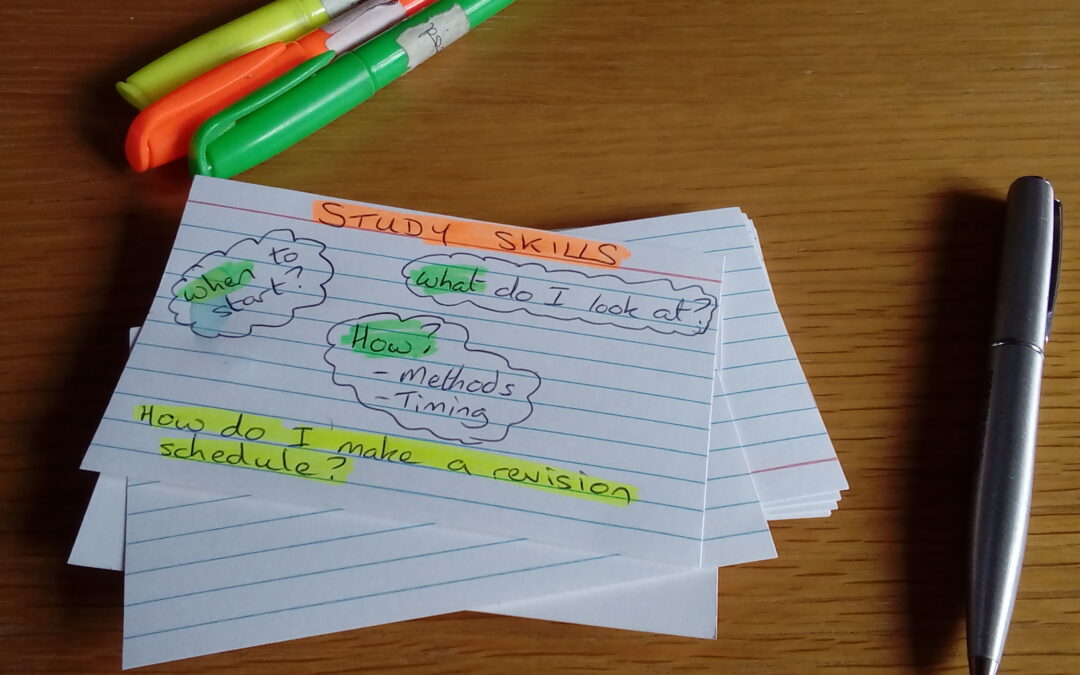
1. Get a schedule ready for the beginning of the new academic year. It may help you to write your weekly and monthly schedule on a planner. Write in your non-academic commitments as well as your academic ones. Be specific. Instead of just writing “Revise”, give a topic name or a chapter number. If you allow time for all the hard thinking at the beginning of the week then you can just follow the schedule for the rest of the week, rather than wasting half your study session working out what you are meant to be doing.
2. Allow time each week for going over the notes you made in class. Edit or re-write those notes, using information from the textbook as well as your class notes. Make flashcards or mind maps if they will help. At the end of each chapter or module, make time to revise that chapter/module to make sure you understood it. If in doubt, ask your teacher! They are much more likely to be helpful if you ask for clarification just a week or so after finishing the topic, rather than a week or so before the exams!
3. Remember to do your own research on a topic instead of just relying on the teacher to spoon-feed you all the information you need. Use textbooks, look things up using reliable internet sources, watch good documentaries.
4. In order to perform at your best academically, you need to take care of your mind and body just like an athlete who is preparing for a major competition.
Feed your brain well by eating a balanced diet, allow for exercise and for relaxing time and look after yourself by getting enough sleep. That starts from the beginning of the course, too!
Who is the author?
Teri is a languages and study skills tutor based in Surrey. She has been teaching adults and children for the last 20 years, including those preparing for GCSE, IGCSE, A Level and adult qualifications.
Good foreign language teachers do their best to keep their own language skills to a high standard and try to be aware of changes in language usage. An important part of that, when money allows, is visiting countries where the target language is spoken and being sure to gather information and useful materials while you are there!
Last December my husband and I visited Geneva to see the Christmas market and also to visit the well-known market at Martigny. It is many years since I lived briefly in Switzerland and I was very much looking forward to going back. Unbeknown to us, we had chosen to visit during the weekend festivities to mark “L’escalade”; the attempted invasion of Geneva in 1602 by Charles Emmanuel 1er, Duke of Savoie. The first inkling that something unusual was happening was the sight of people in 1602 style clothing. Then we were stopped by a young person in costume, keen to sell us a pin badge to mark the event. He and his accompanying adult very kindly explained about the event and pointed us in the right direction for a fantastic display of weaponry and weapons of torture. It wasn’t quite the language practice I had been expecting, but I found myself interpreting from Swiss French to English for the benefit of a couple of international tourists as a very knowledgeable man went into rather graphic detail about interrogation methods of the time! (See photo)
Luckily that wasn’t my only opportunity to brush up on my language skills during our trip. The vagaries of the Swiss Railways online booking system provided a chance for an in-depth discussion with a very helpful member of staff at the ticket office and the various seasonal market stalls gave us lots of practice with the transactional language of shopping. I took the chance to pick up lots of real-language teaching material including marketing information, tourist brochures and a couple of local newspapers.
During the rest of the year, as my teaching schedule doesn’t allow for regular trips away, I try to watch target language TV shows and read target language books. For more modern language usage I try to watch new YouTube videos, particularly on topics of interest to my students. Recent choices include news reports of the wildfires, batch cooking and ideas for saving water. I am looking for recommendations of good podcasts and will be asking my teenage and adult learners for their ideas. What do you do to keep your language skills relevant?
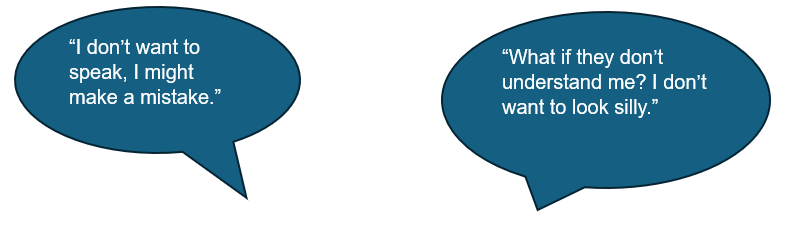
Thoughts like this can be what holds a student back from actually using the language that they have spent time and effort to learn. It is natural to be nervous, and yes, you might make mistakes, but if you never try to use the language then your trip may be more complicated than necessary!
As a school student you may have been used to regular vocabulary tests (which seem to be out of favour in some circles now) or to seeing your hard work given a low mark due to grammar and spelling mistakes. As an adult learner, it is important to remember that the key question is whether you are able to communicate your needs and to have them met. For example, if you have a food allergy are you able to make that clear and therefore be sure that the food on your plate is safe for you? If you need to find a public toilet, are you able to get your message across and find the facilities you need?
Naturally, grammar and tenses are a key component to successful use of a language, but sometimes you will get further by simplifying your message so that it can be clearly understood. For example: “Toilet – where?” or “Toilet where? Please” will almost certainly get you the directions you need in the moment.
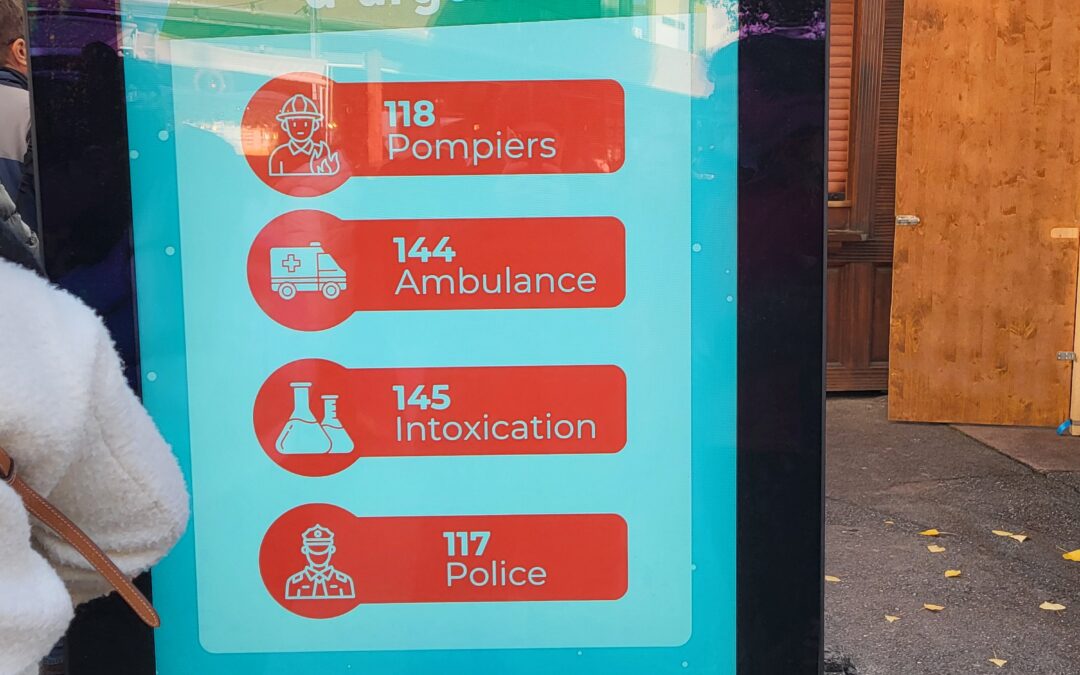
The photo above is of an informational sign at the 2025 Christmas Market in Montreux, Switzerland. As you can see, it uses a mixture of simple images and single words to inform tourists of the important phone numbers they may need in an emergency. Single words so that you can translate them more easily with a dictionary or app, images to back up the translation.
If you are planning a holiday to a country where you are not confident in the language, maybe consider making some images or message cards of your own. A card with your name, important medical information and an emergency telephone number to keep in your wallet; a card for the children to give name, languages spoken and the parent’s telephone number; a small range of cards with messages about things you may need. Each of these may be useful to you and just need a little forward planning.
As the summer holiday season is upon us, I wish you all Happy Adventuring!
June has arrived and as the school exams come to an end, the time has come to think of other types of client. This month we will spend some time thinking about those who are relocating to another country and who may have an added language barrier to add to that experience!
Relocation is a time for new beginnings – but if that new start includes a new country, how do you make the most of that initial time after you arrive? Should you be planning in advance to deal with any language issues or leave it until you get there and see how it goes?
One of the first goals should be integration. It is really important to find out how to navigate around your new home and also to get to know your neighbours, local shopkeepers, schoolteachers and the others who will be able to help you settle in (or who may get upset if you make mistakes!). The following tips will give you a few things to think about:
1. Think about how well you can get along in the language of your new home. Even if your work colleagues will speak English, others may not. Can you introduce yourself and book a hotel/restaurant table? Can you explain about your dietary requirements?
2. Consider the bureaucracy you may need to deal with when you first arrive – some countries will require you to register where you are living as soon as you have accommodation. Can you get hold of a sample form to practise filling in, using the new language?
3. Do think of your family too. If you are relocating together then spend some time thinking about how your partner/children will settle in, as the success of a placement can be as much about family happiness as it is about the workplace.
a. While children are very adaptable, the first day at a new school will be easier if they can understand simple instructions, say their name and ask where the toilet is!
b. For the non-working partner, it can be very frustrating as it can be hard even to go shopping without a basic grasp of the local language. Look for local conversation groups and classes and consider whether the family should take some language classes before you leave.
4. Make time to find out about the customs in your new home. For example: did you know that in Switzerland you are not allowed to do noisy housework on a Sunday? So, no mowing the lawn, washing clothes or getting the vacuum cleaner out.
5. One really good way to make new friends is to join a club or society. You could choose a hobby you already like or pick something new. This is a great way to get out of the house, have something to look forward to as well as meet new people and practise your language skills.
Planning is key to making a success of your new home. Spending a little time on research and preparation should help you all to feel at ease more quickly and to really enjoy that time away. If you have recently arrived in the UK, or are considering relocation to another country then why not give us a call at Language Learners to see how we can help you and your family with your language requirements?
This website uses cookies to improve your experience. We'll assume you're ok with this, but you can opt-out if you wish.AcceptRead More
Privacy & Cookies Policy
Privacy Overview
This website uses cookies to improve your experience while you navigate through the website. Out of these, the cookies that are categorized as necessary are stored on your browser as they are essential for the working of basic functionalities of the website. We also use third-party cookies that help us analyze and understand how you use this website. These cookies will be stored in your browser only with your consent. You also have the option to opt-out of these cookies. But opting out of some of these cookies may affect your browsing experience.
Necessary cookies are absolutely essential for the website to function properly. This category only includes cookies that ensures basic functionalities and security features of the website. These cookies do not store any personal information.
Any cookies that may not be particularly necessary for the website to function and is used specifically to collect user personal data via analytics, ads, other embedded contents are termed as non-necessary cookies. It is mandatory to procure user consent prior to running these cookies on your website.