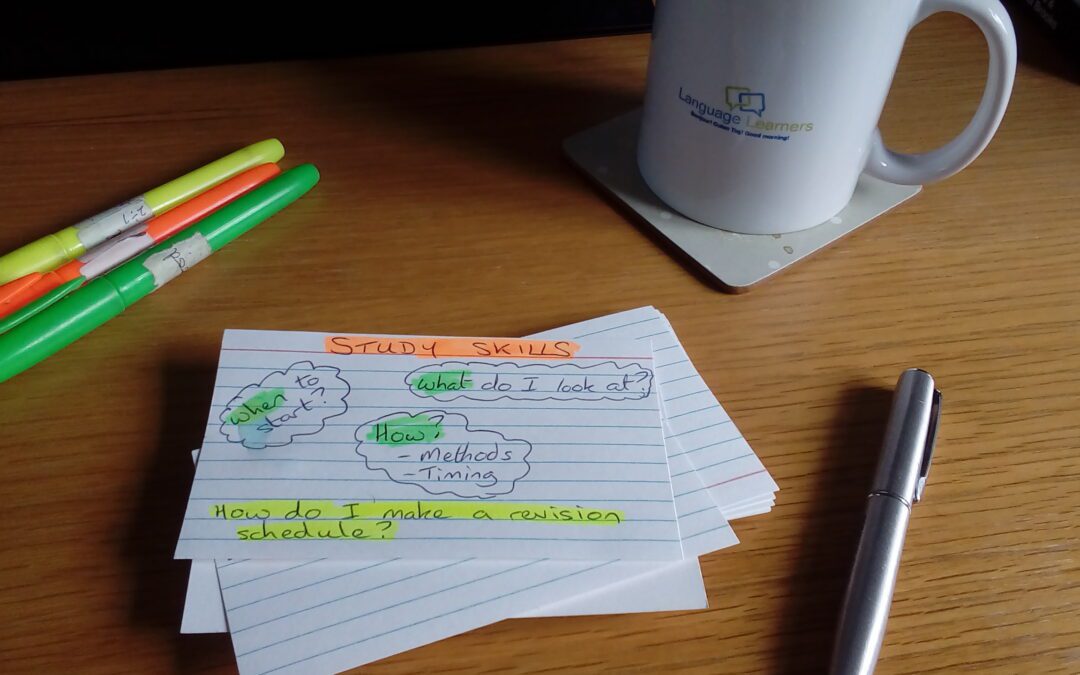
Learning a language involves so many different skills. You may be feeling daunted by the grammar involved in being able to describe things in the past, present AND future, or by different genders for different nouns. One fact that you really cannot avoid though, is that you will need to learn vocabulary at some point. If, like me, that brings back memories of sitting in front of an exercise book with a list of 20 words and trying desperately to memorise them before Monday’s test, then this may not be your favourite task.
The good news is that there are many different ways to learn and that you should be able to squeeze one or two of them into your routine.
Here are 10 tips for learning vocabulary:
Write it down. It seems obvious, but however sure you are that you will remember that “un éclair” is French for “lightning bolt” the chances are that you will soon forget as you focus instead on your next meeting or to-do list. Even better – spend time each week using those new words in a sentence so that you can practice context.
Keep a notebook handy so that you can refer to your lists and add to them whenever you have a spare moment.
When you write down a word, make sure that you include relevant grammatical information too. For some languages the gender of a noun is very important, for verbs it may be the past participle.
“Little and often” is best. The process of moving information from short term memory to long term memory is best achieved by regular practice. You can’t learn to play a musical instrument by doing one four-hour mammoth session per month and the same applies to languages. 10 minutes vocabulary practice 3-4 times per week is better than half an hour the night before your next class!
Keep this week’s vocabulary in an obvious place so you can review it regularly. Maybe that is by the kettle so you re-read it every time you make a cup of tea. Alternatively, maybe by the bathroom mirror so you see it as you clean your teeth. Whatever works for you.
Consider using apps and online resources to help. Programmes such as DuoLingo or their offshoot, Tinycards, can be invaluable as they provide chances for repetitive practice in an easy-to-use format.
If you learn better by doing rather than seeing or hearing, then you may be a kinesthetic learner. Flashcards may be helpful for you. The act of moving the English word to be next to the target language one can help to cement the relationship between them. Even better, in the case of simple nouns, would be to label the objects around you – and to move the labels to repeat the task regularly!
Keep on top of it. 10-20 words per week may seem like a little, but busy lives can get in the way of the best intentions. Before long you have a list of 50 or 100 words and the task begins to look more daunting. Especially in the case of exam students and those with a learning deadline, making sure you keep on top of your vocabulary learning will make revision much less stressful.
Advanced learners – look up other relevant words as well. So, if you have the concept of “lesson” then also look up “learn”, “learner”, “student”, “teacher”. If it is a verb such as “to surprise” then also learn the noun “a surprise”, the adjective “surprising” and the adverb “surprisingly”. This kind of focused work will help you to see the patterns of language formation and also widen your vocabulary beyond the simple first word which you wrote down.
Finally, review your vocabulary regularly. It is easy to add in new words and then forget the old through a lack of practice. If you find that you can no longer recall the word for “shirt” then take time to check you can remember the rest of the wardrobe as well!
If you are really keen you could write mini-tests for yourself as you go. If you keep them in the back of your folder or notebook then you can check regularly which topics are due for revision!
Teri has been learning languages for more years than she cares to remember. More than ¾ of her life has been spent pondering over vocabulary lists and notebooks! She is a successful language trainer and tutor, offering in person and online tuition.
The GCSE and A Level exams are now approaching at a gallop. It really is time to knuckle down and get a revision schedule sorted out so that you make sure you spend enough time on each subject and have a chance to look at all aspects of the curriculum.
Here are a few helpful tips to help you stay on the right path:
#1 Don’t revise for an exam within half a day of taking it.
Exam in the morning? Stop revising for it at lunchtime the day before. Exam in the afternoon? Don’t revise for it that day.
Revising at the last minute just leads to a lack of confidence as you convince yourself that you don’t know anything and will never get a good grade. If you don’t know your stuff that close to the exam, then spending the remaining hours cramming really won’t help!
#2 Little and often is key.
It can be really tempting to leave the final exams until much nearer the date. However, after 4-5 weeks of exams you will be suffering from revision fatigue and you really won’t want to spend hours each day revising for the last one or two. Besides, we can’t focus well for hours on end so that kind of revision is less effective anyway. Schedule in a few revision sessions for those last exams earlier in the month so that you can keep things ticking over nicely.
#3 Take a break every 30 minutes or so.
There is a good reason why school lessons tend to be less than one hour and include a variety of tasks – we cannot focus intensively for much longer than that. Work hard and focus well for 25-30 minutes, then take a short break. Not three hours of social media, but 5-10 minutes to walk around the house or garden, get a drink or something to eat, and stretch. Then sit down for another session.
#4 Vary your revision techniques.
Reading and re-reading the same page again and again only works for a very small minority of people. Try drawing mind-maps, thinking of acronyms to help you remember key info, summarising and re-
summarising to get to the key points. Get busy with the highlighter pens, add stickers to mark the important bits, see what works best for you.
#5 Why not test yourself?
At the beginning of a topic, write yourself a quiz covering 5-10 key pieces of information. When you think you have finished with that topic, try the quiz and see if you can remember the answers without looking in your notes.
#6 Tackle one or two past papers to check your timings.
Time management is an important exam technique as it is vital to leave enough time to tackle all of the questions on the paper. Your teacher may give you some past papers, or you can usually find some on the website for the relevant exam board.
#7 Successful multi-tasking is a bit of a myth.
If you are watching TV, listening to music, checking social media AND revising, then you aren’t concentrating properly on any of them. Book time in your schedule to check email or messaging apps, tell your friends you are going off-line for a while, and allow yourself to really focus.
#8 Remember to leave some downtime in your revision schedule.
Not days or a whole weekend, but careful slots to allow you to exercise, meet friends, go to that party.
#9 Eat well.
Lots of fruit and veg, of course, but also proper good quality protein and carbs. Yes to home-cooked stir fry, stew, bolognaise etc. Proceed with caution when it comes to doughnuts, chocolate and fast food.
#10 Sleep properly.
Although it can be tempting to revise late into the night you have to balance the likelihood of retaining something important read at midnight, with the probability of impaired thinking if you have been up that late!
Whether you are choosing a language tutor for a child, for an adult or for a group, there are several considerations that you may want to bear in mind when it comes to finding the right person for you. Here are some ideas for you if you are looking for someone to tutor a child:
1.If you need a tutor for someone under the age of 18 then do ask for their DBS check if you will be leaving your child alone with them. The DBS (Disclosure and Barring Service) check is the certificate which shows if they have any criminal convictions of relevance to working with children.
2.Consider carefully whether you would be better to have lessons at your home or at the tutor’s premises. Most professional tutors will be unwilling to be left alone with a child in the child’s own home. At Language Learners we insist on an adult being present in the home for any child under the age of 14.
3.Match your tutor to your needs. If you would like your 8-year-old to have a little booster then you may be fine with a University student. However, if your child has specific additional learning needs or is studying for an exam then it may be a good idea to pay extra for someone who has experience of those particular requirements.
4.The GCSE curriculum and exam methods have changed in the last three years – so University students DID NOT sit the same exam that your child will be taking. If you need to be boosting grades then ask your tutor questions about how they have kept their knowledge up-to-date.
5.Have reasonable expectations of what you will be paying. Remember that the minimum wage for someone over 25 is £8.21 per hour at the time of writing. With a good tutor you are not just paying for the one hour of the class, but also for the time they spend planning and marking homework. It can take quite some time to plan a student-specific scheme of work to boost that particular student’s grades in the time available and I am sure it is the same for other subjects/tutors too. As a rough guide, prepare for the cost of the tutor to be similar to the cost of a 1:1 session with a physiotherapist or personal trainer at the gym.
6.If your tutor is just going over the same material that was covered in school, using the same books and worksheets, then it is time for another tutor. They should be adding value by bringing different/more resources. Not that you necessarily want lots of different explanations (that’s confusing) but a range of new exercises and challenges will really help to consolidate the information.
7.Personality. Ensuring that your child gets on well with the tutor and will work nicely for them is a key element. Sometimes two people just don’t get on well, without it being anyone’s fault – so be prepared to review the situation after two or three classes to make sure that both sides are happy.
Teri Fleetwood is the owner of Language Learners and has been providing French and German tutoring to children from age 5 upwards for more than 12 years. Her students consistently exceed expectations at GCSE and A Level through a careful mixture of topic and grammar work as well as a keen attention to exam technique. Language Learners operates mostly in the Woking and Guildford areas of Surrey.
The GCSE and A Level exams are now approaching at a gallop. It really is time to knuckle down and get a revision schedule sorted out so that you make sure you spend enough time on each subject and have a chance to look at all aspects of the curriculum.
Here are a few helpful tips to help you stay on the right path:
#1 Don’t revise for an exam within half a day of taking it. Exam in the morning? Stop revising for it at lunchtime the day before. Exam in the afternoon? Don’t revise for it that day.
Revising at the last minute just leads to a lack of confidence as you convince yourself that you don’t know anything and will never get a good grade. If you don’t know your stuff that close to the exam then spending the remaining hours cramming really won’t help!
#2 Little and often is key. It can be really tempting to leave the final exams until much nearer the date. However, after 4-5 weeks of exams you will be suffering from revision fatigue and you really won’t want to spend hours each day revising for the last one or two. Besides, we can’t focus well for hours on end so that kind of revision is less effective anyway. Schedule in a few revision sessions for those last exams earlier in the month so that you can keep things ticking over nicely.
#3 Take a break every 45 minutes or so. There is a good reason why school lessons last 35-45 minutes – we cannot focus intensively for much longer than that. Work hard and focus well for 45-50 minutes, then take a short break. Not three hours of social media, but 5-10 minutes to walk around the house or garden, get a drink or something to eat, and stretch. Then sit down for another session.
#4 Vary your revision techniques. Reading and re-reading the same page again and again only works for a very small minority of people. Try drawing mind-maps, thinking of acronyms to help you remember key info, summarising and re-summarising to get to the key points. Get busy with the highlighter pens, add stickers to mark the important bits, see what works best for you.
#5 Why not test yourself? At the beginning of a topic, write yourself a quiz covering 5-10 key pieces of information. When you think you have finished with that topic, try the quiz and see if you can remember the answers without looking in your notes.
#6 Tackle one or two past papers to check your timings. Time management is an important exam technique as it is vital to leave enough time to tackle all of the questions on the paper. Your teacher may give you some past papers, or you can usually find some on the website for the relevant exam board.
#7 Successful multi-tasking is a bit of a myth. If you are watching TV, listening to music, checking social media AND revising, then you aren’t concentrating properly on any of them. Book time in your schedule to check email or messaging apps, tell your friends you are going off-line for a while, and allow yourself to really focus.
#8 Remember to leave some downtime in your revision schedule. Not days or a whole weekend, but careful slots to allow you to exercise, meet friends, go to that party.
#9 Eat well. Lots of fruit and veg, of course, but also proper good quality protein and carbs. Yes to home-cooked stir fry, stew, bolognaise etc. Proceed with caution when it comes to doughnuts, chocolate and fast food.
#10 Sleep properly. Although it can be tempting to revise late into the night you have to balance the likelihood of retaining something important read at midnight, with the probability of impaired thinking if you have been up that late!
This website uses cookies to improve your experience. We'll assume you're ok with this, but you can opt-out if you wish.AcceptRead More
Privacy & Cookies Policy
Privacy Overview
This website uses cookies to improve your experience while you navigate through the website. Out of these, the cookies that are categorized as necessary are stored on your browser as they are essential for the working of basic functionalities of the website. We also use third-party cookies that help us analyze and understand how you use this website. These cookies will be stored in your browser only with your consent. You also have the option to opt-out of these cookies. But opting out of some of these cookies may affect your browsing experience.
Necessary cookies are absolutely essential for the website to function properly. This category only includes cookies that ensures basic functionalities and security features of the website. These cookies do not store any personal information.
Any cookies that may not be particularly necessary for the website to function and is used specifically to collect user personal data via analytics, ads, other embedded contents are termed as non-necessary cookies. It is mandatory to procure user consent prior to running these cookies on your website.