Whether you are choosing a language tutor for a child, for an adult or for a group, there are several considerations that you may want to bear in mind when it comes to finding the right person for you. Here are some ideas for you if you are looking for someone to tutor a child:
If you need a tutor for someone under the age of 18 then do ask for their DBS check if you will be leaving your child alone with them.
Consider carefully whether you would be better to have tuition at your home or at the tutor’s premises. Most professional tutors will be unwilling to be left alone with a child in the child’s own home. At Language Learners we insist on an adult being present on the premises for any child under the age of 14.
Match your tutor to your needs. If you would like your 8-year-old to have a little booster then you may be fine with a University student. However, if your child has specific additional learning needs or is studying for an exam then it may be a good idea to pay extra for someone who has more experience of that situation!
The GCSE curriculum and exam methods have changed in the last few years, especially with the changes made during the Covid lockdowns – so University students DID NOT sit the same exam that your child will be taking. If you need to be boosting grades, then ask your tutor questions about how they have kept their knowledge up-to-date.
Have reasonable expectations of what you will be paying. Remember that the minimum wage for someone over 24 is £9.50 per hour (April 2022). With a good tutor you are not just paying for the one hour of the class, but also for the time they spend planning and marking homework. It can take quite some time to plan a student-specific scheme of work to boost that particular student’s grades in the time available. As a rough guide, prepare for the cost of the tutor to be similar to the cost of a 1:1 session with a physiotherapist or personal trainer at the gym.
If your tutor is just going over the same material that was covered in school, using the same books and worksheets, then it is time for another tutor. They should be adding value by bringing different/more resources. Not that you necessarily want lots of different explanations (that’s confusing) but a range of new exercises and challenges will really help to consolidate the information.
Personality. Ensuring that your child gets on well with the tutor and will work nicely for them is a key element. Sometimes two people just don’t get on well, without it being anyone’s fault – so be prepared to review the situation after two or three classes to make sure that both sides are happy.
Teri Fleetwood is the owner of Language Learners and has been providing French and German tutoring to children from age 5 upwards for more than 16 years. Her students consistently exceed expectations at GCSE and A Level through a careful mixture of topic and grammar work as well as a keen attention to exam technique. Language Learners offers in-person tutoring as well as online sessions.
Learning a language involves so many different skills. You may be feeling daunted by the grammar involved in being able to describe things in the past, present AND future, or by different genders for different nouns. One fact that you really cannot avoid though, is that you will need to learn vocabulary at some point. If, like me, that brings back memories of sitting in front of an exercise book with a list of 20 words and trying desperately to memorise them before Monday’s test, then this may not be your favourite task.
The good news is that there are many different ways to learn and that you should be able to squeeze one or two of them into your routine.
Here are 10 tips for learning vocabulary:
Write it down. It seems obvious, but however sure you are that you will remember that “un éclair” is French for “lightning bolt” the chances are that you will soon forget as you focus instead on your next meeting or to-do list. Even better – spend time each week using those new words in a sentence so that you can practice context.
Keep a notebook handy so that you can refer to your lists and add to them whenever you have a spare moment.
When you write down a word, make sure that you include relevant grammatical information too. For some languages the gender of a noun is very important, for verbs it may be the past participle.
“Little and often” is best. The process of moving information from short term memory to long term memory is best achieved by regular practice. You can’t learn to play a musical instrument by doing one four-hour mammoth session per month and the same applies to languages. 10 minutes vocabulary practice 3-4 times per week is better than half an hour the night before your next class!
Keep this week’s vocabulary in an obvious place so you can review it regularly. Maybe that is by the kettle so you re-read it every time you make a cup of tea. Alternatively, maybe by the bathroom mirror so you see it as you clean your teeth. Whatever works for you.
Consider using apps and online resources to help. Programmes such as DuoLingo or their offshoot, Tinycards, can be invaluable as they provide chances for repetitive practice in an easy-to-use format.
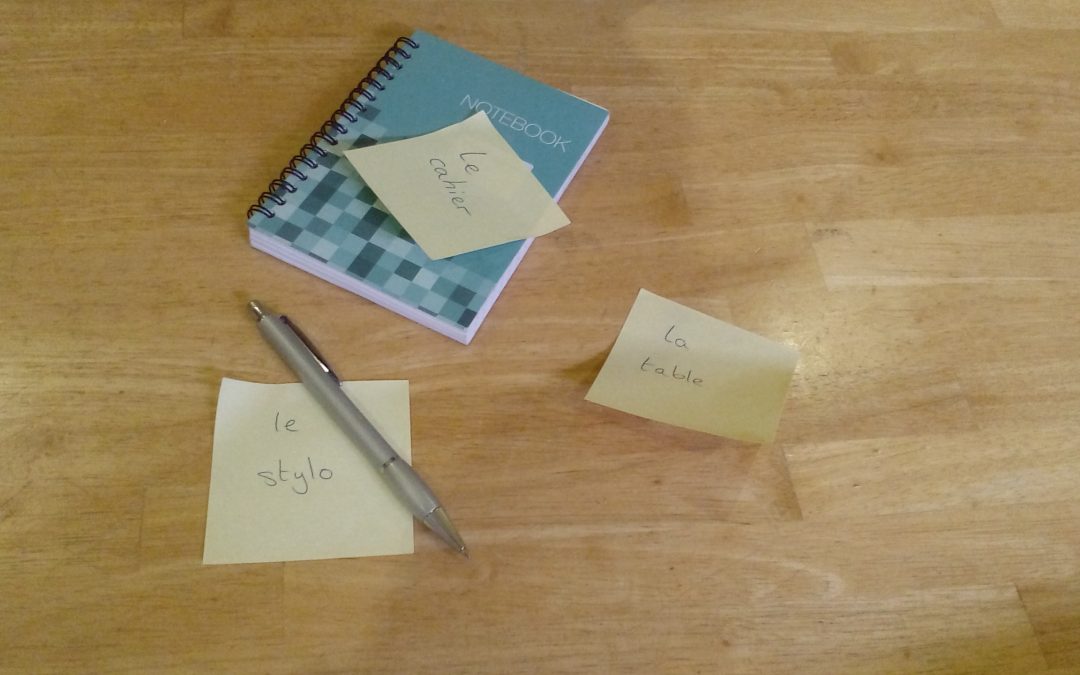
If you learn better by doing rather than seeing or hearing, then you may be a kinesthetic learner. Flashcards may be helpful for you. The act of moving the English word to be next to the target language one can help to cement the relationship between them. Even better, in the case of simple nouns, would be to label the objects around you – and to move the labels to repeat the task regularly!
Keep on top of it. 10-20 words per week may seem like a little, but busy lives can get in the way of the best intentions. Before long you have a list of 50 or 100 words and the task begins to look more daunting. Especially in the case of exam students and those with a learning deadline, making sure you keep on top of your vocabulary learning will make revision much less stressful.
Advanced learners – look up other relevant words as well. So, if you have the concept of “lesson” then also look up “learn”, “learner”, “student”, “teacher”. If it is a verb such as “to surprise” then also learn the noun “a surprise”, the adjective “surprising” and the adverb “surprisingly”. This kind of focused work will help you to see the patterns of language formation and also widen your vocabulary beyond the simple first word which you wrote down.
Finally, review your vocabulary regularly. It is easy to add in new words and then forget the old through a lack of practice. If you find that you can no longer recall the word for “shirt” then take time to check you can remember the rest of the wardrobe as well!
If you are really keen you could write mini-tests for yourself as you go. If you keep them in the back of your folder or notebook then you can check regularly which topics are due for revision!
Teri has been learning languages for more years than she cares to remember. More than ¾ of her life has been spent pondering over vocabulary lists and notebooks! She is a successful language trainer and tutor, offering in person and online tuition.
Going on holiday with children? Going to a country where English is not the first language? Here are some tips from us to help make the holiday a bit easier, and to encourage your children to learn more about the country too!
Talk to your children about the language/s spoken at your destination. Help them to understand that not everybody speaks the same language.
Learn some key phrases together. Words like “please” and “thank you” in the local language can bring a much better level of service, especially when they are used by the younger members of the party!
Find out about the local food specialities and talk about what you might like to try. Sounding excited about it will help to encourage your child to try new things.
If you have a real favourite food, see if you could take some with you. A few familiar snacks can go a long way to soothing tired and frustrated children. They can also be life-savers if the flight is delayed!
While on your holiday, try to point out words and phrases that you know. Keeping an eye out for things such as “toilet”, “exit” or even “ice cream” can entertain the youngsters in a strange town and help them to see the point of learning a new language.
Why not encourage your child to use the language themselves? The sense of pride when they successfully buy bread at the baker, ask for their own ice cream, or order the train tickets themselves (depending on age) is something that could stick with them for a long time. One year we encouraged our children to order their own drinks, with the promise of a hot chocolate with cream if they could ask for it themselves!
Think about the worst case scenario – what if your child gets lost? Consider giving them a contact card to keep in a pocket. It could include key information such as their name, the languages they speak, any medical conditions and your mobile number or accommodation details. A bit of time taken to get this information in the destination language could save a lot of time and hassle if your little one gets lost. You could do the same for adults too, just in case!
Teri Fleetwood is an experienced language tutor with over 16 years experience of tutoring to the GCSE and A Level curriculum. For more information please look at the rest of the posts in this blog and also check our Facebook page https://www.facebook.com/LanguageLearnersSurrey/ If you would like to discuss 1:1 or small group tuition, whether for exam preparation or pleasure, then do get in touch! teri@language-learners.com
Ahhhh…. The GCSE exams are over and a long summer stretches ahead of you. Sun (maybe), friends, relaxation, summer homework…! Hang on! Summer homework?
It may come as a surprise to some of those preparing for sixth form, but it isn’t unheard of for sixth form colleges to set homework for the new intake to complete over the summer. This may seem a bit unfair, mean even, but you will be in a much stronger position to start your A Levels in September if you have taken some time over the holidays to review what you know and start on your more advanced material.
What would our suggestions be for those who are looking at an A Level in a modern foreign language such as German, French or Spanish?
I would always recommend finding out which board your school/college will be using and to check out the details of the specification online. You can find out what is expected in the exams, what you will be studying and even some information about the marking scheme.
A good second step is to find out which film and/or book you will be studying. Make sure that you have a copy of your own and try to watch/read it at least TWICE before the start of the term. It is true that the teachers are paid to go through the material with you, but it will make much more sense to you if you have at least some idea of the plot. Buy a copy in the target language (e.g. German) and see if you can also get a good English translation. In this way you can read the English quickly to grasp the key points, then read the target language version in more detail as you have some idea of what is happening. Many schools and colleges will look at either the film or the book in the first year of A Level and then tackle the other one in the second year. This is helpful as it spreads the workload more evenly – so be prepared to do similar studying in the summer holidays following your first year of the course, so that you are in good shape for the second year.
Take time to look at and learn some of the grammar. The jump from a good grade at GCSE to the higher expectations of A Level can be a large one. It is possible to get a higher grade at GCSE by essentially learning blocks of text (useful phrases and grammar constructions) but not really understanding them. Buy a good grammar guide and get practising so that you have less work to do at the beginning of the new term. Make sure that you understand all the tenses you will be required to use, how to form them, when to use them, how the irregular verbs behave. As a guide, get comfortable with the present, past (perfect, imperfect, pluperfect), future (both kinds for French) and conditional. Really comfortable, not just “well, yes, sort of”.
It is important to get as much listening practice as possible. Use online resources such as news websites to find articles that you can listen to as well as read. Euronews (www.euronews.com), Deutsche Welle (www.dw.com) and 1jour1actu (www.1jour1actu.fr) are all good examples.
Consider whether it would be helpful to set up or join a conversation group to improve your confidence in speaking your target language. This doesn’t have to be an expensive option as you may be able to find like-minded students from your own sixth form or from another local one so you can meet together for the price of a coffee.
Teri Fleetwood is an experienced language tutor with over 16 years experience of tutoring to the GCSE and A Level curriculum. For more information please look at the rest of the posts in this blog and also check our Facebook page https://www.facebook.com/LanguageLearnersSurrey/ If you would like to discuss 1:1 or small group tuition, whether for exam preparation or pleasure, then do get in touch! teri@language-learners.com
This website uses cookies to improve your experience. We'll assume you're ok with this, but you can opt-out if you wish.AcceptRead More
Privacy & Cookies Policy
Privacy Overview
This website uses cookies to improve your experience while you navigate through the website. Out of these, the cookies that are categorized as necessary are stored on your browser as they are essential for the working of basic functionalities of the website. We also use third-party cookies that help us analyze and understand how you use this website. These cookies will be stored in your browser only with your consent. You also have the option to opt-out of these cookies. But opting out of some of these cookies may affect your browsing experience.
Necessary cookies are absolutely essential for the website to function properly. This category only includes cookies that ensures basic functionalities and security features of the website. These cookies do not store any personal information.
Any cookies that may not be particularly necessary for the website to function and is used specifically to collect user personal data via analytics, ads, other embedded contents are termed as non-necessary cookies. It is mandatory to procure user consent prior to running these cookies on your website.