The New Year has arrived and many of us will be making resolutions to get fit, be healthy or be more organised in our study. If you are learning a new language or trying to become more proficient in one you already speak, then these five great habits will help you make consistent progress throughout the year.
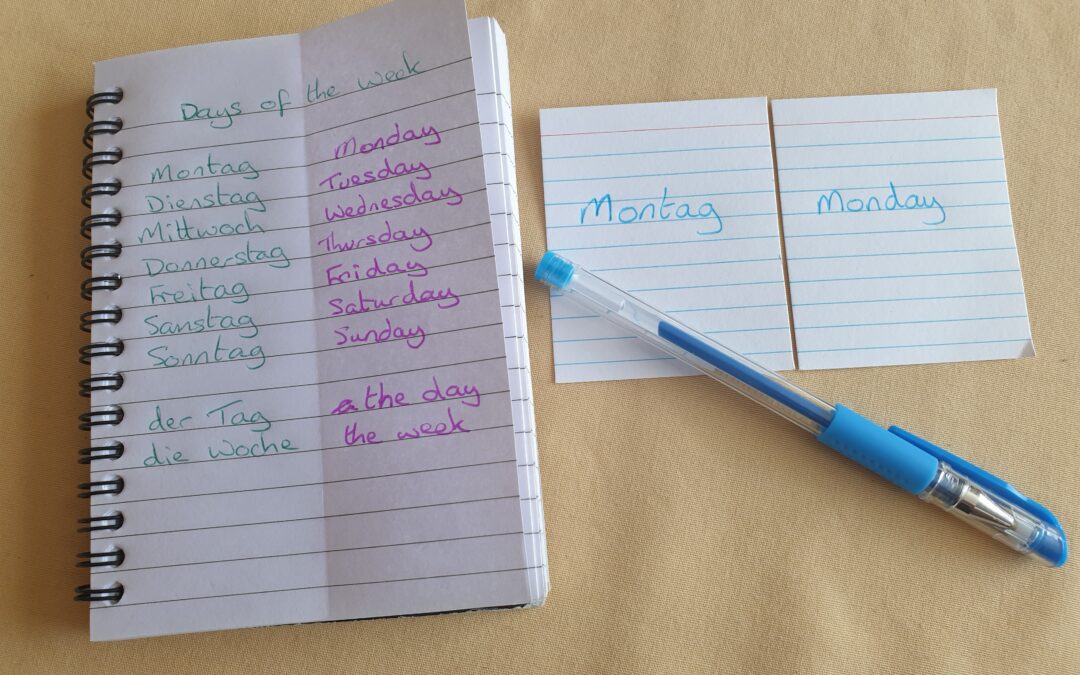
1. A Vocabulary Book.
Way back when I was at school (not quite as long ago as Queen Victoria!), we had vocabulary notebooks. These were brought out for every lesson and we carefully noted down the new words so we could learn them for our weekly vocab test. Schools and learning methods have moved on but I still recommend one of these as you can take it with you from year to year, it gathers all the useful words together by topic and the teacher won’t deprive you of it while they mark your homework.
How to set one up? It’s fairly simple – buy a notebook (an A5 one is fine, A6 may be easier to fit into a pocket). Fold the page down the middle, lengthways, so that you have two columns. Write the title at the top and then the target language in the left column and your home language in the right column. Bingo. If you are tackling a short topic such as numbers, then one or two pages will do. If you think the topic may end up as a long one, for example food, then leave a spare page or two so you can add extra words later.
Important – when writing down your new words make sure you include the gender and the plural if it is a noun, details if it is irregular, the past participle if it is a verb and any other useful information. As one example, German has three different genders for nouns, and you definitely don’t want to have to go back and re-learn them all in time for your exams! You could try highlighting them in a different colour for each gender.
2. A Grammar Folder.
There will be lots of grammar concepts to learn in the new language. If you have already been learning the language for a while, then you may have come across multiple tenses and other grammar rules. It can be a real pain having to flick through old exercise books or piles of papers from several years ago in order to find something, so having all that information in one place can be a real blessing.
How to set one up? Buy an A4 folder, in whatever colour you like, and a couple of sets of dividers. Each time you learn a new grammar concept e.g. the future tense, adjective endings, word order etc, write it up onto a sheet of paper with a clear title. Use highlighter pens, underlining, diagrams or whatever seems appropriate. Then file it in your folder under an appropriate subject heading e.g. “Tenses”.
3. Sticky Notes.
Whether you use them for your shopping list or to leave messages for the family, sticky notes are a common sight in many homes. Whether you get plain yellow ones, coloured ones, funny shapes or the ones which look like speech bubbles, they can be fantastic for vocabulary learning. The obvious idea is to label the items you are trying to learn e.g. “window”, “cupboard”, “fridge” but you could also just write any other word that you need to learn and then stick them up around the home as a regular reminder. Move them around regularly so you don’t get too used to them – or write your target language on one note and your home language on another, then try to match them up. Invest. Invest in sticky notes, now!
4. Regular Practice Time.
Trying to learn a new grammar idea or a list of words is much better done in several short bursts each week rather than one mammoth session. Vocabulary is more likely to stay in your memory if you have practised more than once. You could try focused learning for 10 minutes, three times per week. Or do as some of our students do and put your list near the kettle (or next to your bathroom mirror) so you see it regularly.
5. Vocab Tests.
Whether or not you have regular vocabulary tests during your lessons, it is a simple thing to write a list of the words you are learning (just your home language) and then slip it into a folder for later. When it comes to revision time you have a handy set of tests you can use to see how well you know the topic. This can be useful for adult learners too!
It will take a bit of time and effort to set up these habits to start with, but they will really help you to improve your knowledge of the language and to retain new vocabulary and grammar concepts in the long term.
It’s December, so I feel fairly well justified in mentioning Christmas. If you are one of those people who has already bought and wrapped all the gifts by early September, then this blog may give you ideas ready for next year! Otherwise, for those who, like me, are not quite done yet (or haven’t even started), here are some ideas of gifts to help the linguist in your life. (PS – They are suitable for birthdays too!)
Story dice
Essentially, these are a set of cubes with a different picture on each side. They are great for encouraging young learners to tell stories and use their imagination. They can also be a super helpful prompt for adult learners who just need a few ideas to help them practise tenses, adjectives, story flow, question formation… or so many other aspects of language learning. I own two sets so that I have a wider range of pictures. One of them is featured in this video:
When we think of Bingo, do we think of large groups of seniors gathered in the village hall for a fundraiser, or maybe one of those larger halls owned by a company who offer nothing but bingo? It may not be your personal idea of fun, but a bingo set can be a great resource when it comes to practising numbers. You can play in the classic way, or alternatively try one of these:
Everyone picks three numbers which they keep secret. Take it in turns to say your number in your target language, then the others write it down. Who gets the most right?
Use the bingo tiles or balls to make longer numbers by placing them next to each other. Phone numbers and prices can both be done in this way. Then practise saying the number.
Books
If you are learning a language, then this probably makes you think of grammar workbooks, or textbooks. Why not give the gift of a real story book, with vocabulary and comprehension exercises included? Olly Richards and Richard Simcott are the authors of a set of French books including both beginner and intermediate levels. These come highly recommended by my students!
If the person you are buying for is a fluent speaker, then they may be delighted by a magazine on a topic of interest to them. Cookery, gardening, celebrity gossip – it’s all out there in their target language just the same as in English. Alternatively, if the recipient is a teenager, or a newer learner, then Mary Glasgow magazines are a great option. French, German, Spanish or English, there are a range of levels available with engaging content and some extra vocabulary help.
The jump from a good grade at GCSE to the higher expectations of A Level can be a large one. Some students feel unprepared for the expectations of independent study and don’t know where to start, let alone how to structure their time efficiently. If your school tell you to do 10 hours per week independent study on top of what they already set, where do you start? This is especially true with a foreign language where it can be hard to know what to look at or which techniques to use to maximise the return on your time investment. Here are some tips to help you structure your independent study time.
1. A good place to start is by going over your notes from the classes or lectures you have had that week. Don’t leave it too long, or you will forget what was said and may struggle to make sense of your notes.
Re-write your notes if you need to add more details and get busy with highlighter pens and underlining so that you can easily see the key points.
If you have time, write yourself a quiz now, using the information in your notes to form the basis of the questions. Put the quiz in a separate place for later use, so that you have a ready-made resource when it comes to revision time.
2. If you find that there was something you didn’t understand, ask NOW. Ask a friend, look it up in a book or online (make sure your resources are good quality ones!) or even go back to the teacher/lecturer and ask for clarification. Far better to do that within the fortnight, rather than waiting until exam time.
3. With specific regard to languages, it is important to get as much listening practice as possible. Use online resources such as news websites to find articles that you can listen to as well as read. Euronews (www.euronews.com), Deutsche Welle (www.dw.com) and 1jour1actu (www.1jour1actu.fr) are all good examples.
4. Make time to watch the film and/or read the book that you are studying. You are not just watching/reading for pleasure, but you should also be making notes about characters, themes, motivations. Try to get hold of the study guide for that particular work.
5. Vocabulary learning! You may not have a good vocabulary-learning routine in place yet, but this is something that you will need to make dedicated time for if you are to succeed in your exams. Learn the word, its gender, any other related words (the noun from the verb for example). Use active learning methods rather than just reading the paper, and test yourself regularly.
Language Learners can help with the question of independent study and note-taking skills through our Study Skills tutoring sessions. These classes are ideal for those making the jump between GCSE and A Level or for those who are facing exams this year and aren’t sure how to manage their time in order to fit in revision as well as essays and other commitments.
We can help students to establish a regular schedule of personal study on top of their academic and social commitments, as well as giving a range of tips on independent research, essay planning and exam technique.
Learning a language involves so many different skills. You may be feeling daunted by the grammar involved in being able to describe things in the past, present AND future, or by different genders for different nouns. One fact that you really cannot avoid though, is that you will need to learn vocabulary at some point. If, like me, that brings back memories of sitting in front of an exercise book with a list of 20 words and trying desperately to memorise them before Monday’s test, then this won’t be your favourite task.
Sadly, I lost my “photographic” memory when life got busy and my brain filled with other important things like appointments and to do lists. The good news though is that there are many different ways to learn and that you should be able to squeeze one or two of them into your routine. Here are 10 tips for learning vocabulary:
Write it down. It seems obvious, but however sure you are that you will remember that “un éclair” is French for “lightning bolt” the chances are that you will soon forget as you focus instead on your next meeting or to-do list.
Keep a notebook handy so that you can refer to your lists and add to them whenever you have a spare moment.
When you write down a word, make sure that you include relevant grammatical information too. For some languages the gender of a noun is very important, for verbs it may be the past participle.
“Little and often” is best. The process of moving information from short term memory to long term memory is best achieved by regular practice. You can’t learn to play a musical instrument by one three-hour mammoth session per month and the same applies to languages. 10 minutes vocab practice 3-4 times per week is better than half an hour the night before your next class!
Keep this week’s vocabulary in an obvious place. Maybe that is by the kettle so you can review it every time you make a cup of tea. Alternatively, maybe by the bathroom mirror so you see it as you clean your teeth. Whatever works for you.
Consider using apps and online resources to help. Programmes such as DuoLingo or their offshoot, Tinycards, can be invaluable as they provide chances for repetitive practice in an easy-to-use format.
If you learn better by doing rather than seeing or hearing, then consider making flashcards. The act of moving the English word to be next to the French one can help to cement the relationship between them. Even better, in the case of simple nouns, would be to label the objects around you – and to move the labels to repeat the task regularly!
Keep on top of it. 10-20 words per week may seem like a little, but busy lives can get in the way of the best intentions. Before long you have a list of 50 or 100 words and the task begins to look more daunting. Especially in the case of exam students and those with a learning deadline, making sure you keep on top of your vocabulary learning will make revision much less stressful.
Advanced learners – look up other relevant words as well. So, if you have the concept of “lesson” then also look up “learn”, “learner”, “student”, “teacher”. If it is a verb such as “to surprise” then also learn the noun “a surprise”, the adjective “surprising” and the adverb “surprisingly”. This kind of focused work will help you to see the patterns of language formation and also widen your vocabulary beyond the simple first word which you wrote down.
Finally, review your vocabulary regularly. It is easy to add in new words and then forget the old through a lack of practice. If you find that you can no longer recall the word for “shirt” then take time to check you can remember the rest of the wardrobe as well!
If you are really keen you could write mini-tests for yourself as you go. If you keep them in the back of your folder or notebook, then you can check regularly which topics are due for revision!
Teri has been learning languages for more years than she cares to remember. More than ¾ of her life has been spent pondering over vocabulary lists and notebooks! She is a language trainer and tutor, focusing on adult learners.
This website uses cookies to improve your experience. We'll assume you're ok with this, but you can opt-out if you wish.AcceptRead More
Privacy & Cookies Policy
Privacy Overview
This website uses cookies to improve your experience while you navigate through the website. Out of these, the cookies that are categorized as necessary are stored on your browser as they are essential for the working of basic functionalities of the website. We also use third-party cookies that help us analyze and understand how you use this website. These cookies will be stored in your browser only with your consent. You also have the option to opt-out of these cookies. But opting out of some of these cookies may affect your browsing experience.
Necessary cookies are absolutely essential for the website to function properly. This category only includes cookies that ensures basic functionalities and security features of the website. These cookies do not store any personal information.
Any cookies that may not be particularly necessary for the website to function and is used specifically to collect user personal data via analytics, ads, other embedded contents are termed as non-necessary cookies. It is mandatory to procure user consent prior to running these cookies on your website.