
Learning a language involves so many different skills. One fact that you really cannot avoid though, is that you will need to learn vocabulary at some point. If, like me, that brings back memories of sitting in front of an exercise book with a list of 20 words and trying desperately to memorise them before Monday’s test, then this may not be your favourite task.
The good news is that there are many different ways to learn and that you should be able to squeeze one or two of them into your routine. Here are 10 tips for learning vocabulary:
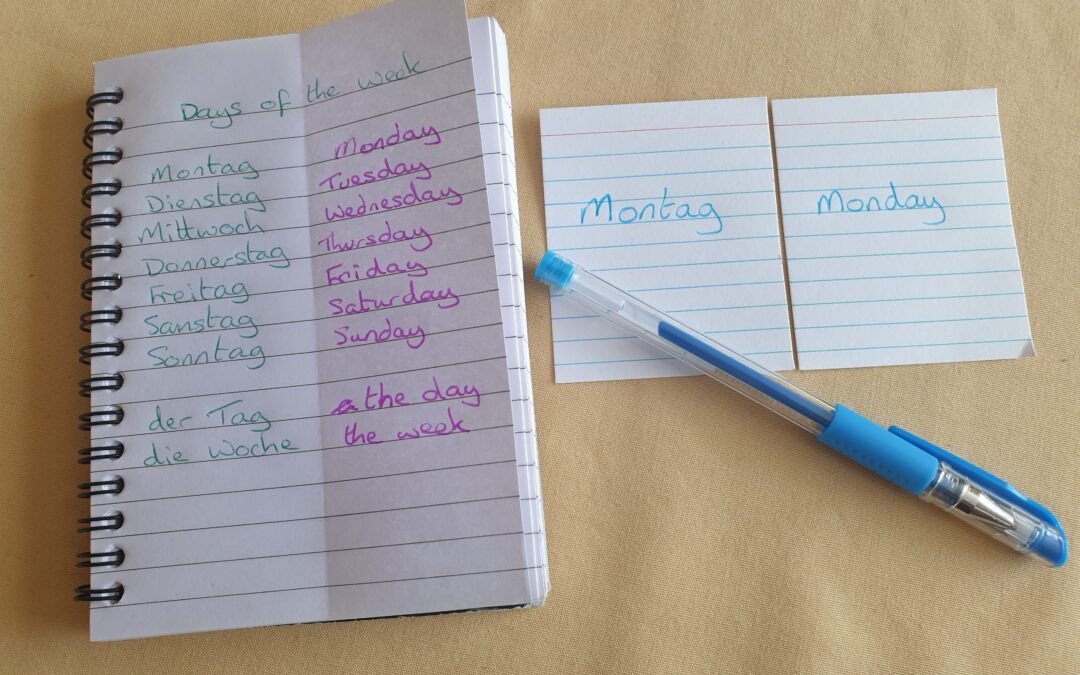
- Keep a vocabulary notebook handy so that you can keep all your vocabulary in one place. When you see a new word, write it down. It seems obvious, but however sure you are that you will remember that “un éclair” is French for “lightning bolt” the chances are that you will soon forget as you focus instead on your next meeting or to-do list.
- Can you make any mental links to help you remember the word? For me, the above example gives a mental picture of chocolate eclairs raining down, accompanied by a soundtrack of thunder.
- Even better – spend time each week using those new words in a sentence so that you can practice context.
- When you write down a word, make sure that you include relevant grammatical information too. For some languages the gender of a noun is very important, for verbs it may be the past participle.
- “Little and often” is best. The process of moving information from short term memory to long term memory is best achieved by regular practice. You can’t learn to play a musical instrument by doing one four-hour mammoth session per month and the same applies to languages. 10 minutes vocabulary practice 3-4 times per week is better than half an hour the night before your next class!
- Keep this week’s vocabulary in an obvious place so you can review it regularly. Maybe that is by the kettle so you re-read it every time you make a cup of tea. Alternatively, maybe by the bathroom mirror so you see it as you clean your teeth. Whatever works for you.
- Consider using apps and online resources to help. Programmes such as DuoLingo can be invaluable as they provide chances for repetitive practice in an easy-to-use format.
- If you learn better by doing rather than seeing or hearing, then you may find that flashcards are helpful. You can make physical flashcards, or use software such as Quizlet for an online version.
- Keep on top of it. 10-20 words per week may seem like a little, but busy lives can get in the way of the best intentions. Before long you have a list of 50 or 100 words and the task begins to look more daunting. Especially in the case of exam students and those with a learning deadline, making sure you keep on top of your vocabulary learning will make revision much less stressful.
- Advanced learners – look up other relevant words as well. So, if you have the concept of “lesson” then also look up “learn”, “learner”, “student”, “teacher”. If it is a verb such as “to surprise” then also learn the noun “a surprise”, the adjective “surprising” and the adverb “surprisingly”. This kind of focused work will help you to see the patterns of language formation and also widen your vocabulary beyond the simple first word which you wrote down.
Finally, review your vocabulary regularly. It is easy to add in new words and then forget the old through a lack of practice. If you find that you can no longer recall the word for “shirt” then take time to check you can remember the rest of the wardrobe as well!
If you are really keen you could write mini-tests for yourself as you go. If you keep them in the back of your folder or notebook then you can check regularly which topics are due for revision!
Please come back next month to read Learning Vocabulary Part 2: 5 Study Tips 🙂